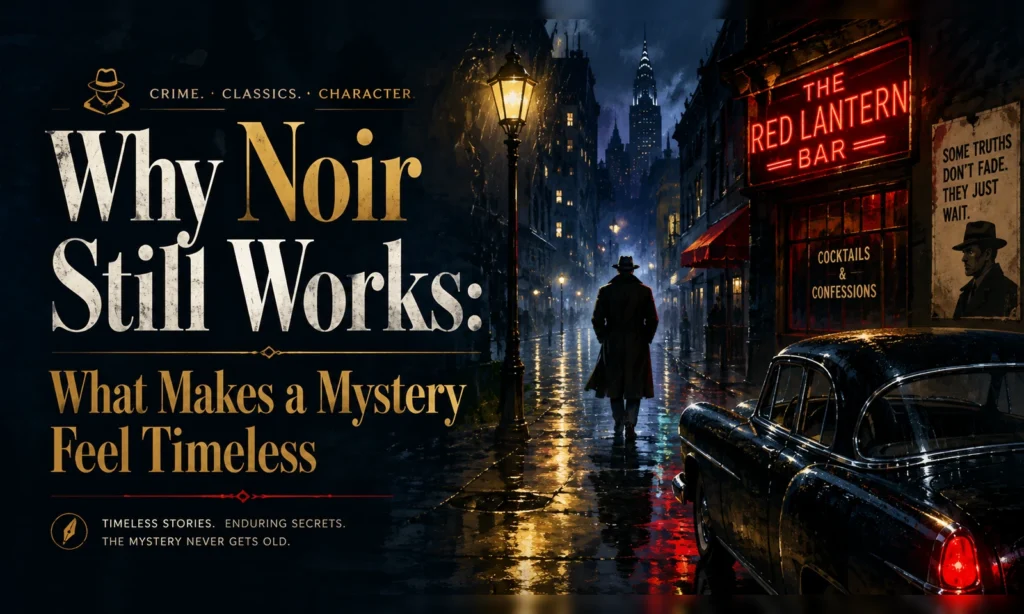
There is something about noir that refuses to disappear.
The clothes change. The cities change. The technology changes. But the basic feeling remains the same: a person walks into a situation that looks ordinary at first, then slowly realizes that almost nothing is what it seems.
That tension is one reason noir still works.
At its best, noir is not really about trench coats, shadows, cigarette smoke, or rain-slicked streets. Those things help create the mood, but they are not the real engine. The real engine is uncertainty.
Those questions do not belong to one decade. They belong to every decade.
Noir Begins With Doubt
A timeless mystery usually starts by creating doubt.
The main character may think they understand the situation, but the reader senses that something is off. A person is lying. A detail does not fit. A story has a missing piece.
That gap between what appears to be true and what is actually true creates suspense.
Noir takes that uncertainty and pushes it further. It often places the main character in a world where institutions cannot automatically be trusted. Police, business owners, politicians, friends, family members, or respectable public figures may all have private motives.
That makes the mystery feel larger than a simple question of who committed the crime.
The Best Noir Is About People, Not Puzzles
A clever plot matters, but mystery becomes memorable when the people matter more than the mechanics.
Readers may enjoy guessing who did it, but what stays with them is usually the emotional cost.
A good noir story often centers on characters dealing with grief, guilt, fear, betrayal, ambition, or regret. The mystery gives those emotions a structure.
That is why older noir stories can still feel modern. Human motives have not changed very much.
People still lie because they are afraid. They still hide things because they are ashamed. They still betray others because they want money, power, safety, revenge, or love.
A mystery becomes timeless when the crime reveals something recognizable about human behavior.
Atmosphere Matters More Than Era
Noir is strongly associated with the 1940s and 1950s, but its atmosphere is not limited to those years.
The strongest noir creates a sense of pressure. A room feels too quiet. A street feels too empty. A conversation seems polite, but something underneath it feels dangerous.
That atmosphere can exist in Harlem in 1947, Los Angeles in 1975, or a modern city today.
The setting changes, but the emotional temperature does not.
A Strong Mystery Gives the Reader Something to Chase
Every effective mystery needs forward movement.
There has to be a reason to keep turning pages or keep listening.
That usually comes from a combination of questions: What happened? Why did it happen? Who benefits? What is the main character missing? What will happen if the truth comes out?
The best mysteries do not answer everything at once. They reveal just enough to make the next discovery feel necessary.
That rhythm is especially important in audio storytelling, where each scene needs to create a reason to hear the next one.
Noir Works Because Justice Is Complicated
Traditional stories often promise that truth will lead to justice. Noir is less certain.
The truth may be discovered, but that does not mean everyone is punished. The hero may win, but lose something important in the process. A crime may be solved while the larger system that allowed it remains untouched.
That tension makes noir feel mature. It recognizes that people can do the right thing and still pay a price.
Why the Genre Still Has Power
Noir continues to work because it understands something basic about suspense: people are fascinated by secrets.
We want to know what is behind the closed door. We want to hear the part of the story someone tried to bury. We want to understand why a person made the choice that changed everything.
And perhaps most of all, we want to know whether the person searching for the truth will still be the same person once they find it.
The streets may change. The technology may change. The language may change.
But the mystery remains.
From ALonder Publishing
That same fascination with secrets, consequences, and hidden motives is part of the foundation behind The Red Ribbon, the first Ike Freeman story from ALonder Publishing.
It is not the shadows alone that make noir work. It is what people choose to hide inside them.