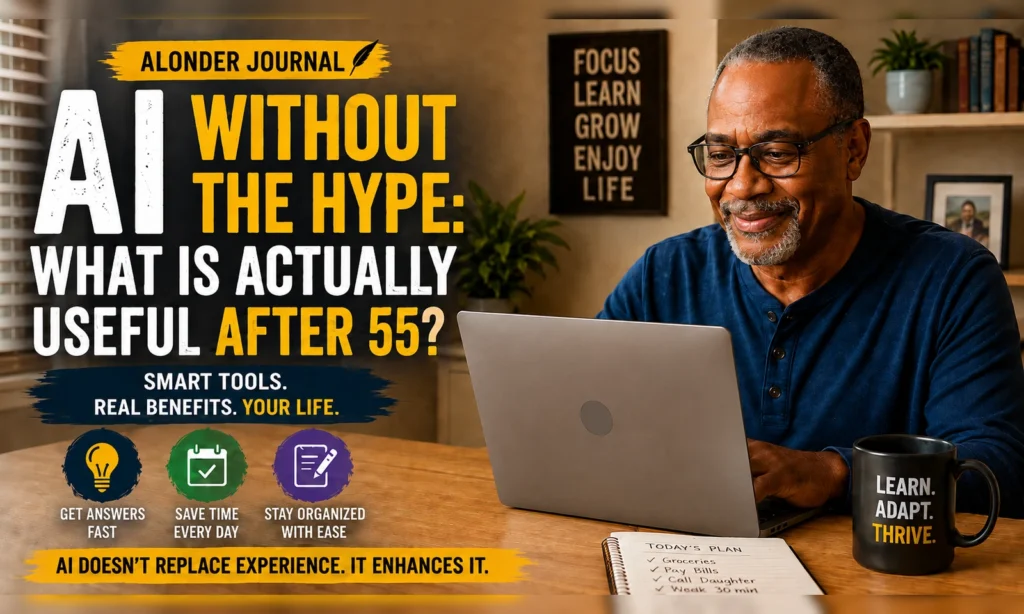
Artificial intelligence is everywhere right now.
For adults over 55, all of the headlines, new tools, and predictions can create a reasonable question: Do I really need to learn this?
The answer is not that everyone needs to become an AI expert. You do not.
But learning a few practical ways to use AI may be worth your time.
You Do Not Have to “Learn AI”
One of the biggest mistakes beginners make is thinking they must first understand how artificial intelligence works.
You do not need to understand the engine to drive the car.
For everyday purposes, using an AI assistant is often much closer to having a conversation. You type what you want, read the response, and ask follow-up questions.
The useful skill is not programming. It is learning how to explain what you need.
A Strong Everyday Example: Planning a Trip
Suppose you and your spouse are considering a three-day trip to Charleston.
Traditionally, you might spend an evening searching dozens of websites for hotels, restaurants, attractions, parking, walking distances, and opening hours.
Instead, you could ask an AI assistant:
Then refine it: remove an attraction, ask for rainy-day alternatives, identify what needs reservations, or turn the plan into a one-page checklist.
You still make the decisions and verify current prices, hours, transportation, and availability. AI simply removes a large amount of the organizational work.
AI Can Help Explain Difficult Information
Government letters, insurance explanations, technology instructions, product manuals, travel rules, retirement documents, and bank correspondence can all be harder to understand than necessary.
You can paste non-sensitive text into an AI assistant and ask: “Explain this in plain English.”
Then ask: “What are the three things I need to pay attention to?”
It Can Help You Write the Message You Have Been Putting Off
Maybe you need to contact a contractor, write your homeowners association, explain a problem to customer service, or send a thoughtful note.
Tell the AI what happened and what you want the message to accomplish. Let it produce a first draft, then edit it until it sounds like you.
AI Can Help With Hobbies and Personal Interests
AI does not have to be about work. It can help build a reading list, research classic movies, organize a genealogy project, create family-history interview questions, plan a garden, brainstorm meals, build a vacation itinerary, or explain a new piece of technology.
AI Can Help You Ask Better Questions
Imagine you are getting estimates for a new roof. Ask AI to create a checklist of questions for each contractor and a comparison table covering price, warranty, materials, cleanup, scheduling, and insurance.
The AI has not selected the contractor for you. It has helped you become a better-informed customer.
Older Adults Bring Something Important to AI
There is sometimes an assumption that AI belongs primarily to younger people. That is a mistake.
AI can produce a quick answer. Experience helps you recognize whether the answer makes sense.
AI can suggest ten options. Judgment helps you eliminate nine of them.
AI can draft a letter. Life experience tells you whether the tone is appropriate.
There Are Things You Should Not Hand Over to AI
Do not assume an AI answer is automatically correct. Be especially cautious with medical diagnoses, medication decisions, investment decisions, taxes, contracts, legal disputes, passwords, Social Security numbers, banking credentials, and highly sensitive personal documents.
A useful rule is: Use AI to help you understand and prepare. Use qualified people and authoritative sources to make important decisions.
Free and Low-Cost Places to Learn
Beginner-friendly AI learning resources
- Senior Planet from AARP — Free technology classes and workshops, including AI-related topics designed for older adults. Visit Senior Planet
- AARP Digital Skills — Free technology learning resources and guidance for older adults. Explore AARP Digital Skills
- Microsoft Learn — Free self-paced learning, including beginner AI modules. Visit Microsoft Learn
- IBM SkillsBuild — Free online technology and AI education for adult learners. Explore IBM SkillsBuild
- Google AI Essentials — A beginner-oriented, self-paced course covering practical AI use and prompting. Pricing can vary, so check the current enrollment cost before signing up. Explore Google AI Essentials
Start With One Useful Task
Do not start by trying to master AI. Pick one thing you already need to do.
Ask it to help plan dinners, explain instructions, create a family-event checklist, or prepare questions before hiring a contractor.
Try one. Look at the answer. Ask another question. That is how you learn — by using the technology on something that actually matters to you.
AI Without the Hype
If you are over 55, you have already lived through enormous technological change: personal computers, the internet, smartphones, online banking, streaming television, and more.
AI is another change. You do not have to embrace every part of it, but it is worth understanding enough to decide where it belongs in your life.
The best question is not, “How do I keep up with artificial intelligence?”
It is: “Is there something I already do that AI could make easier?”
From ALonder Publishing
The Learning section of ALonder Publishing focuses on helping people use new technology without getting buried in technical language or unnecessary hype.
For adults 55 and older, AI does not need to become another subject to study. It can simply become another useful tool.